
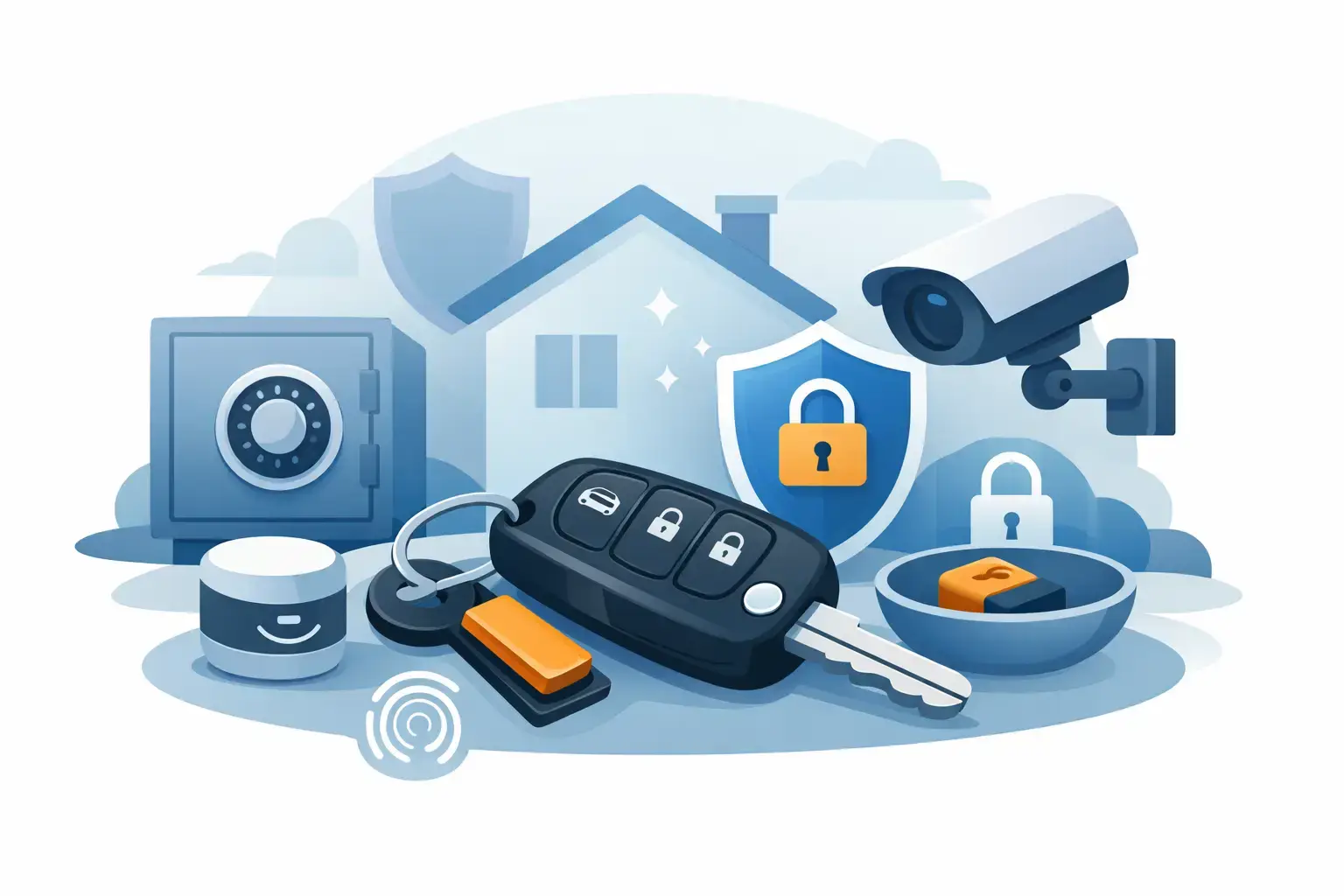
A thief does not always need to break a window or force a lock. If your car uses keyless entry, they may be able to capture and extend the signal from a key left near the front door, then drive away in minutes. That is why the best ways to protect car keys at home start with where you keep them, but should not end there.
For families, commuters, tradespeople and delivery drivers across the West Midlands, a missing key or stolen vehicle can stop the whole day. A few practical changes at home can reduce that risk considerably and make it less likely that a small mistake becomes an expensive emergency.
Keep keys away from doors, windows and letterboxes
The convenient bowl, hook or side table in the hallway is usually the worst place for modern car keys. It puts them close to the point a thief is most likely to approach and makes them visible or reachable through a window, letterbox or poorly secured door.
Store keys well inside the property, ideally in a room that cannot be easily seen from the street. The further they are from external walls, doors and ground-floor windows, the harder it is for criminals using relay equipment to detect a keyless fob’s signal.
Avoid leaving keys on a kitchen counter beside a rear door as well. A key hidden from the front of the house can still be exposed through a side gate, conservatory or accessible window. Choose one secure, repeatable location and make it part of the household routine.
Use a tested Faraday pouch for keyless fobs
A Faraday pouch or signal-blocking box is one of the most effective defences against keyless relay theft. It blocks the radio signal your fob continually emits, preventing equipment outside the property from communicating with it.
The quality of these products varies. Do not assume a pouch works because it looks like one. Test it when you first buy it: place the key inside, stand beside the car and try the door handle. If the vehicle still unlocks, the signal is not being blocked properly. Replace worn pouches too, as folds, tears and damaged lining can reduce their effectiveness.
A metal tin may help in some cases, but it is not a guaranteed solution. A purpose-made, tested pouch or box is the safer choice. Keep every keyless fob inside it when it is not in use, including the spare.
Do not forget the spare key
Spare keys are often left in a drawer near the entrance, in an obvious kitchen cupboard or with a relative who does not use signal-blocking storage. That creates a weak point in an otherwise sensible setup.
Treat the spare key with the same care as the main one. Keep it out of sight, away from external walls and in a signal-blocking pouch if it is keyless. Never leave it in the car, garage, glovebox or a magnetic box under the vehicle. These locations are familiar to thieves and can invalidate the practical value of having a spare at all.
Make car-key security part of your evening routine
The strongest security measures are the ones you will actually use every day. Make a quick check part of locking up at night: keys stored securely, car locked, windows closed and valuables removed.
If you share a vehicle, agree on one place for each set of keys. This reduces the chance of someone putting a fob back on the hall table after a long day. It also saves time when you need to leave for work, school runs or an early call-out.
For households with teenagers or frequent visitors, explain why this matters. Keyless theft can sound technical, but the action is simple: do not leave vehicle keys close to the outside of the house.
Protect the car as well as the keys
Keeping the key secure is only one part of preventing theft. A thief may use another route if the car itself has limited physical protection. For vehicles at higher risk, use visible and practical deterrents such as a steering wheel lock, driveway security lighting and, where suitable, a wheel clamp.
A steering wheel lock will not make a vehicle impossible to steal, but it adds time, noise and difficulty. That can be enough to encourage an opportunist to move on. Park in a well-lit area where possible, preferably on a driveway or somewhere visible from the house rather than hidden behind hedges or down a dark side street.
If your vehicle has an app, connected services or remote features, use a strong, unique password and enable two-factor authentication where available. Do not share account access casually. Your digital account can be as valuable to a criminal as the fob in your pocket.
Check whether your vehicle needs an anti-theft upgrade
Some vehicles are targeted more often because criminals know common weaknesses. Keyless relay theft is one issue, but electronic theft methods can also involve the vehicle’s diagnostic port, door wiring or programming systems. The right protection depends on the make, model, age and existing security features of your car or van.
Modern security upgrades can make unauthorised key programming or electronic entry more difficult. Options may include diagnostic-port protection, security reprogramming, keyless-entry settings and additional physical deterrents. Not every upgrade suits every vehicle, so avoid buying a generic fix without checking compatibility.
A qualified automotive locksmith can assess the key type, identify obvious vulnerabilities and explain the practical choices without drowning you in jargon. For owners of newer cars, vans carrying tools or models with a history of theft, that assessment can be worthwhile before a problem occurs.
Do not label your keys with your address
A keyring engraved with your full address, postcode or vehicle registration makes life easier for someone who finds or steals it. Even a work pass, gym tag or loyalty card attached to your keys can reveal more than you intend.
Use a simple, unidentifiable keyring instead. If you need a contact method for lost keys, use a dedicated recovery tag or a phone number that does not reveal your home address. Keep house keys separate from car keys where practical, particularly if your car documents are stored in the vehicle.
This is especially relevant when your keys are handed over at a garage, valet service, hotel or workplace. You may trust the business, but keys can be misplaced, photographed or picked up by the wrong person. Give away as little personal information as possible.
Know what to do if a key is lost or stolen
Act quickly. If you cannot account for a key, do not wait a week in the hope that it turns up. Move the car to a safer location if you can, use any additional security devices you have and contact an automotive locksmith for advice.
Depending on the vehicle, it may be possible to erase the missing key from the car’s memory and programme new keys. This means the lost or stolen fob should no longer start the vehicle, even if somebody later finds it. You may also need a lock change or rekey where there is a risk that the thief has access to the mechanical key blade.
Tell your insurer if the circumstances require it, and keep records of the work completed. If keys were stolen alongside documents that identify your address or vehicle, treat it as an urgent security issue rather than a routine replacement.
Alex Auto Locksmith Services provides mobile help for lost, damaged and stolen car keys, as well as security upgrades for drivers who want to reduce the risk before it becomes an emergency. Fast action can restore both access and peace of mind without unnecessary damage or disruption.
The simple habit that makes the biggest difference
Most car-key protection comes down to consistency. Put keyless fobs in a tested Faraday pouch, keep all keys away from external doors and windows, and give the spare key the same protection as the one you use every day. Those few seconds at the end of the day are far easier than dealing with a stolen vehicle, a missed shift or a stranded family car.