
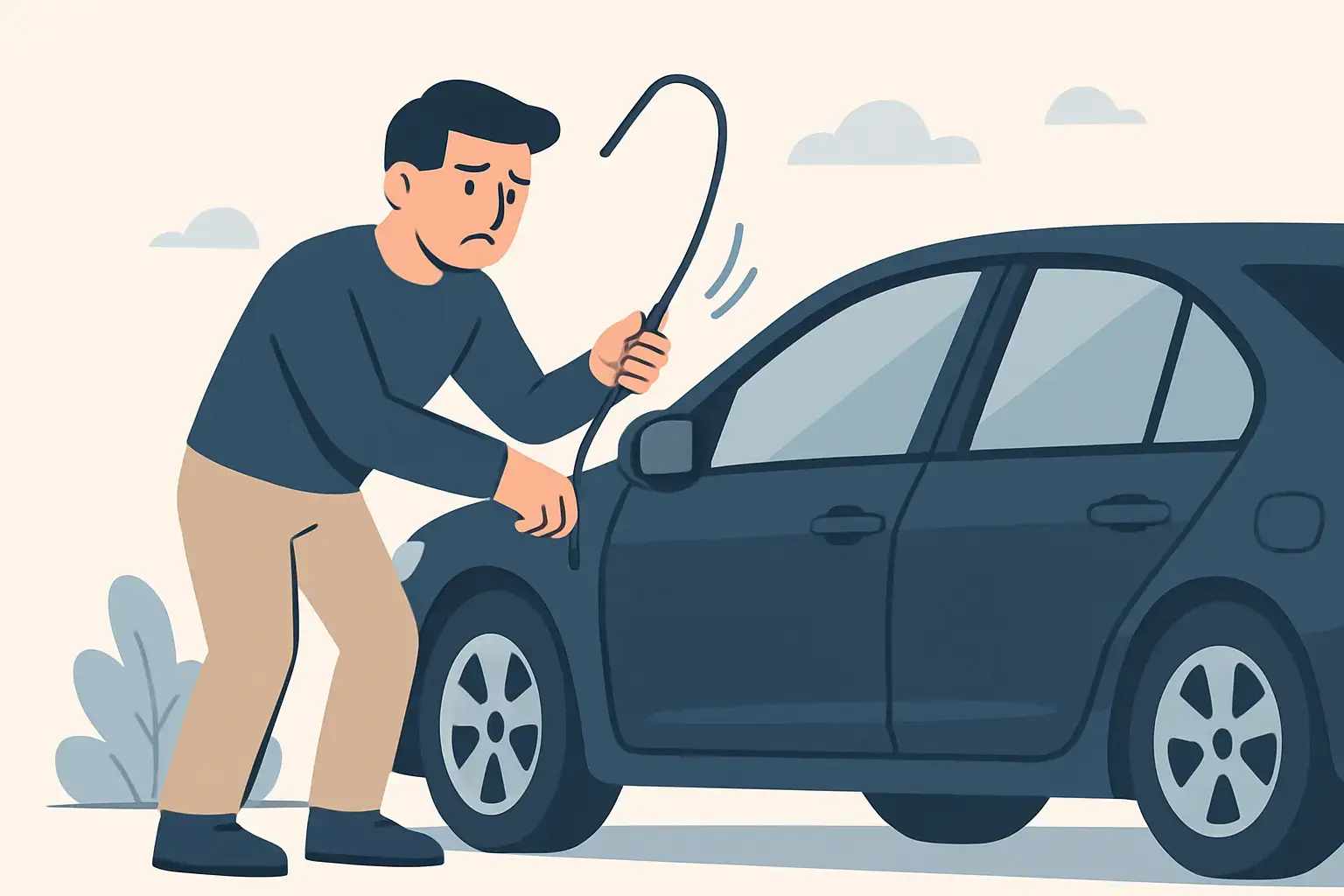
You are stood next to your car in a hurry, keys in plain sight on the seat or missing entirely, and the first thought is usually, “I’ll just get it open.” The second thought should be, “Not at the expense of the paint.” A scraped door edge, chipped lacquer, or bent frame can cost far more than the lockout itself – and it can also create wind noise and leaks that stick around long after the stress has passed.
This guide is focused on how to unlock car without damaging paint in the real world – the quick checks that save you effort, the safer DIY options that reduce risk, and the clear line where a professional entry is the cheapest outcome.
First, stop the damage before it starts
The biggest paint damage happens in the first 60 seconds, when someone grabs a key, screwdriver, or coat hanger and starts levering. Modern doors, seals, and window frames are not designed for that kind of force. Even if you manage to pop a lock, you can leave a permanent mark where the tool slipped, or you can distort the top of the door and ruin the seal.
Before you touch anything, take ten seconds to change the conditions. If it is dark, use your phone torch so you are not working blind. If it is raining, do not wedge anything against a wet, gritty seal – that grit becomes sandpaper. If you are on a roadside, make sure you are not stepping into traffic while you tug at a door.
Now do the simplest check properly: try every door and the boot. It sounds obvious, but you would be surprised how often a rear door is not fully latched, or the boot will open on a hatchback even when the cabin is locked.
Work out what type of lockout you have
The safest method depends on what is stopping you getting in.
If the keys are inside the car and the car is fully locked, your options are limited – and DIY carries more risk. If the key fob is not responding, you may not be locked out at all. You might have a flat fob battery, a weak car battery, or a key that has lost synchronisation.
If the key turns in the door but will not open it, the issue might be a failed mechanical linkage, a frozen lock, or a security setting. Forcing it can snap the key or damage the cylinder.
And if you have a dead battery and a car that only responds to central locking, you need a method that restores power or uses a mechanical entry point without prising panels.
Getting this right saves paint because it stops you attacking the wrong area of the car.
The least risky DIY steps (that do not touch the paint)
If you want to try something yourself, start with options that keep tools away from the door edge.
Check the key fob battery. Many fobs will still work intermittently with a weak battery – sometimes holding the fob right next to the start button or steering column helps the immobiliser read it. If your vehicle has keyless start, look for the emergency start procedure in your handbook.
Use the mechanical key blade if your fob has one. A lot of drivers do not realise their “remote” key contains a hidden blade. It is usually released by a small catch on the fob. The important bit for paint protection is what you do next: insert it straight and gently. Do not twist hard if it feels gritty or stuck. A small amount of lubricant designed for locks can help, but avoid household oils that attract dirt.
If the car battery is flat and you can access the bonnet release from outside (some models allow it, many do not), you can restore power and then use the remote. Do not attempt to force the bonnet or grille – that is bodywork damage, not just paint.
These steps are boring, but they are boring in a way that keeps your door edges pristine.
If you must try a wedge method, protect the paint properly
People wedge the top of the door to create a small gap, then use a long reach tool to press the unlock button or pull a handle. Done badly, it scrapes paint, tears seals, and bends frames. Done carefully, it can work – but “carefully” is doing a lot of heavy lifting here.
If you are determined to try, do not use metal wedges, screwdrivers, or anything sharp. The only relatively paint-friendly option is a purpose-made inflatable air wedge, used with a protective barrier. The barrier matters because even a soft tool can grind grit into the clear coat.
Use a clean microfibre cloth folded several times between the wedge and the door frame. If you do not have a cloth, a clean cotton T-shirt is better than nothing. Avoid paper towels or anything abrasive.
Inflate slowly. The goal is a minimal gap, not a visible bend in the door. If you see the window frame flexing significantly, stop. The paint might survive, but the door alignment may not.
Even with a small gap, the next problem is control. A long rod can slip and scrape the inside trim, jab a switch, or hit the glass. If your car has side airbags in the door or pillar, poking tools inside the cabin area is not a smart gamble.
This is where “it depends” becomes real: on older vehicles with a simple pull-up lock or a clear unlock button, it is more feasible. On newer cars, especially with complex trim and security features, it often turns into escalating force and escalating damage.
Why the coat hanger trick is a fast route to scratches
The classic coat hanger method is famous for a reason – it sometimes works on older cars with exposed lock mechanisms. But it is also one of the easiest ways to damage paint and seals.
To get a hanger in, you usually have to pry a gap somewhere. A bare metal hook will scrape window tint, mark trim, and can score paint if it touches the door edge. It can also rip the rubber seal, which then whistles at speed and lets water in.
If you are reading this because you are tempted to try it, the practical advice is simple: do not. If paint preservation is the goal, the coat hanger is working against you.
Avoid these “quick fixes” if you care about the finish
There are a few approaches that routinely create damage or bigger bills.
Snapping or forcing the window is not just a mess – it can also damage the window channel and regulators, and you still need access sorted afterwards.
Levering the door near the latch or handle is a guaranteed way to chip paint on the edge and crease the skin of the door.
Trying to pick the lock with improvised tools can scar the cylinder face and leave visible marks around the keyway, especially on gloss black trims.
If you want a clean outcome, avoid anything that relies on brute force or “just a bit more pressure”.
When calling a locksmith is actually the paint-safe option
There is a point where the most cost-effective choice is the one that prevents collateral damage. If the keys are visible inside and you are thinking about wedges, metal rods, or forcing the frame, you are already at that point.
A professional automotive locksmith is set up for controlled, damage-free entry. That means proper wedges, protective shims, and the experience to choose the least risky entry point for your specific vehicle. It also means not turning a lockout into a door seal replacement or a trip to the body shop.
If you are in the West Midlands and need fast help, Alex Auto Locksmith Services is a mobile emergency service with 24/7 availability, an advertised 15-minute average response time, and fully insured work – the kind of reassurance you want when you are stressed and watching the minutes tick by.
What to do while you are waiting (so nothing gets worse)
If you have called for help, your job is to keep the situation stable. Keep trying the remote occasionally if the issue might be signal-related, but do not repeatedly yank door handles. If the keys are inside and the sun is strong, check quickly whether a child or pet is in the vehicle – if there is any safety risk, treat it as urgent and say so when you call.
If you are parked in a tight bay, leave space around the driver’s door so the technician can work without rubbing against the next car. Paint damage is not always caused by tools – it is also caused by rushed movement in cramped spaces.
And if you have already attempted entry and there is tape or cloth on the frame, leave it in place until help arrives. Pulling it off in a hurry can drag grit across the paint.
A few paint-saving habits for next time
Lockouts happen, but you can reduce the odds and reduce the chaos.
Keep a spare key plan that fits your life. That might be a spare with a trusted family member, or a safe storage routine at home. For vans and work vehicles, it is worth having a clear key custody habit so keys do not get left on shelves, in loading bays, or on the seat while you shut the door.
Replace weak fob batteries early. If your remote range has dropped or the car only responds after several presses, change it before it fails completely.
If your vehicle is higher risk for theft, consider security upgrades that address modern techniques. The less you have to “mess about” with locks and entry points in a hurry, the better your paint and trim will look over time.
A locked car is frustrating. A locked car plus scratched paint is the kind of frustration that lingers every time you walk up to it. When you feel that urge to force it, pause and choose the option that keeps the car looking like it did yesterday – even if that option is simply getting a professional to open it cleanly and getting on with your day.